




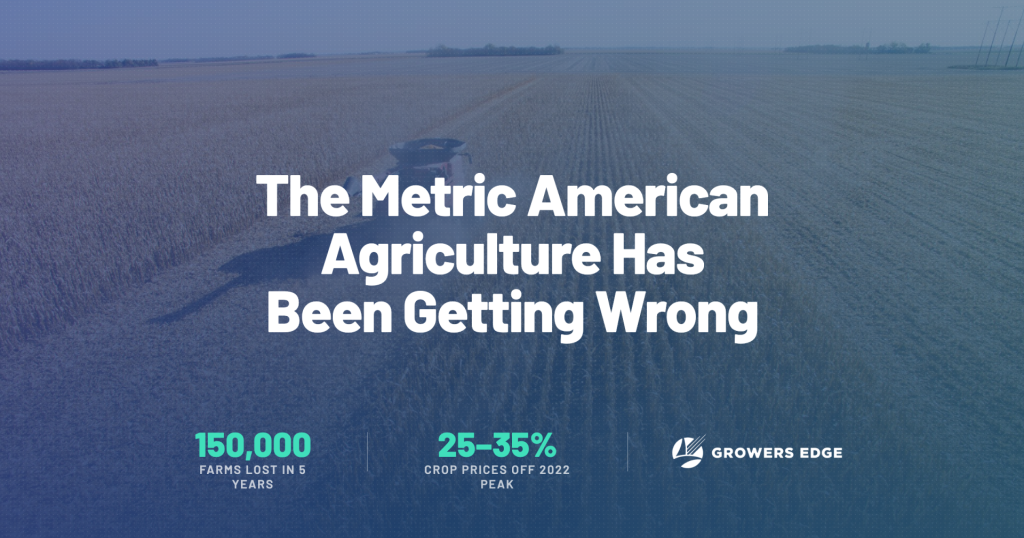
The country has lost nearly 150,000 farms in five years. Net farm income depends on irregular government payments just to stay near its historical average. A new strategy report from S2G Investments argues these facts point to the same underlying problem: American agriculture has spent decades measuring success the wrong way.
The measure has been yield per acre: how many bushels, how many pounds, how much per acre. By that standard, farming has never done better. American farmers grow more per acre, on less land, with fewer people, than any generation before them.
By almost every other measure, the system is more fragile than it looks. The report’s central claim is that yield per acre measures how much a farm produces, but says nothing about how much a farmer actually keeps once every input cost, every risk, and every bad year gets counted. It calls for a different measure: risk-adjusted profit per acre, which tracks what a farmer keeps rather than what a farm grows.
That reframe changes what counts as progress. A farmer who uses fewer inputs, takes on less risk, and earns a smaller but more reliable margin is succeeding under this measure, even with lower yield. A farm hitting record yields while bleeding money on inputs and carrying unmanaged risk is not, no matter what the harvest numbers say.
The report points to several reasons the system hasn’t gotten there yet, and three matter most for where Growers Edge already operates.
Farmers who want to grow something other than the handful of commodities the system already rewards have no reliable buyer for it. Food manufacturers want nutrient-dense ingredients they often cannot find domestically at the scale and consistency they need, and the market connecting that demand to an actual field was never built.
Concentration on both sides of the farm gate has removed the price signal that would normally come from negotiation. A small number of companies control the seed and crop protection inputs farmers buy. On the other end, four companies process roughly 85% of U.S. beef, with similarly tight concentration in pork, poultry, and grain handling. In many regions, a farmer has one or two realistic buyers for what they grow.
The report also points to a financing gap, and the numbers behind it are stark. Input costs reset sharply higher after 2022 and stayed elevated, while commodity prices for corn, soybeans, and wheat have fallen 25% to 35% from their 2022 peaks. That gap alone puts pressure on a farm’s finances before a farmer even considers trying something different.
A farmer who wants to grow something different, a new crop, a new rotation, a healthier alternative to what they’ve always planted, faces a few lean years before it pays off. The new crop yields less at first, and the costs are less familiar. There’s no track record yet to prove it will work, and conventional financing wasn’t built for that kind of stretch. Crop insurance and standard operating loans assume a farmer keeps growing what they grew last year, with payments scheduled around that same, predictable pattern. A farmer making a change needs the downside covered while the new system proves itself, and a lower cost of capital for taking the chance in the first place. Growers Edge already builds both.
Crop Plan Warranty is that backstop: it absorbs the cost when a new crop protection product or a new rotation underperforms, so a farmer or retailer can test it head-to-head against what they already trust, without betting the season on the outcome. Input Financing removes the other kind of risk a retailer faces when a grower wants to try something new: the credit risk sits with the financing partner, not the retailer, and buy-down options bring the grower’s actual cost down for the season they’re taking that chance.
Crop Plan Warranty and Input Financing both lower what a farmer risks in trying something new, which is closer to the actual problem the report is describing than any change to what gets planted. Plenty of farmers are willing to make that change already. What’s been missing is a way to make it without staking the whole operation on the outcome.
Keeping more of what’s already in the field matters more than growing a bigger harvest. That’s the part of this market that’s already being built.