




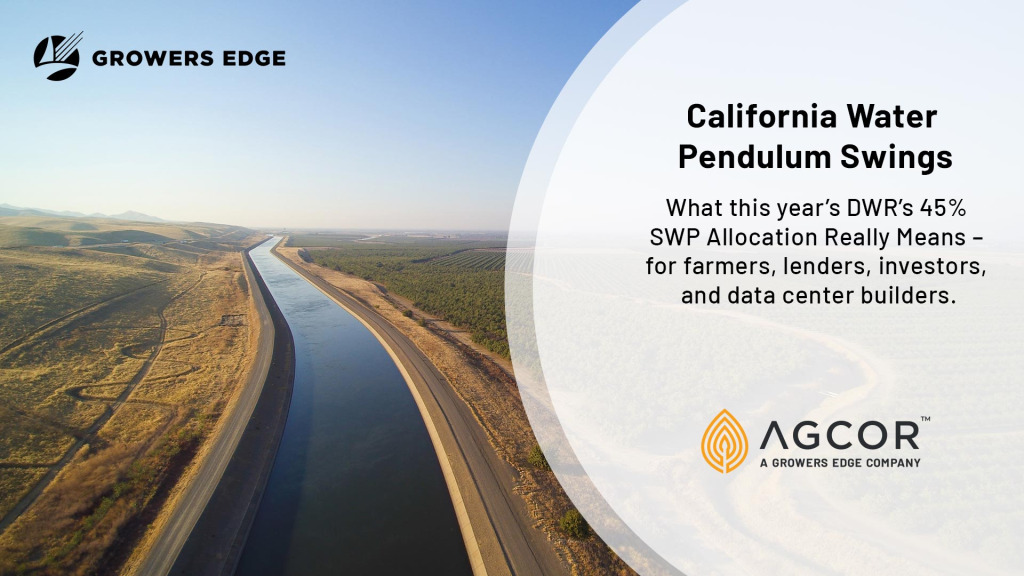
California’s water year started cautiously. On December 1, the Department of Water Resources (DWR) issued an initial State Water Project (SWP) allocation of just 10% of requested supplies — a conservative but standard opening move heading into an uncertain winter. Two months later, December storms pushed that number to 30%. And this week, with reservoirs at or above historical averages — Lake Oroville and Folsom full, Shasta near capacity — DWR moved the allocation to 45%.
That’s a 4.5x increase from the opening call, and it matters well beyond the water districts receiving the deliveries.
What’s Driving the Increase
The SWP serves 29 public water agencies delivering to 27 million Californians and 750,000 acres of farmland. DWR sets allocations monthly based on hydrological conditions, reservoir storage, snowpack, and projected runoff — and this season delivered on multiple fronts.
Notably, a December amendment to DWR’s Incidental Take Permit from the California Department of Fish and Wildlife granted new operational flexibility around “first flush” pumping actions — the rules that curtail Delta diversions during early storm events to protect listed species. That adaptive management decision captured an additional 15,000 acre-feet in December and January alone. In a system this tightly managed, that kind of regulatory agility is increasingly where the margin lives.
The final allocation call typically comes in May or June. At 45% with full reservoirs and meaningful carryover storage heading into summer, the system is performing well — but the season’s story isn’t over yet.
Implications by Sector
For Farmers and Water Districts
A 45% allocation in mid-May is welcome — but let’s be clear about what it can and can’t do. Planting decisions were made months ago. Permanent crops are already in full irrigation demand. Annual crop acres are in the ground. The window for this news to influence crop selection or acreage commitment has closed.
This timing gap isn’t unique to 2026, and it isn’t going away. It’s a structural feature of a changing climate. California’s precipitation regime is shifting toward shorter, more intense wet seasons — more atmospheric rivers, less predictable snowpack, faster runoff. DWR itself acknowledged as much in the January allocation notice, noting that “the assumption of dry conditions is increasingly important given the shrinking and warming of California’s traditional precipitation season.” The water system is learning to capture what it can, when it can. But the agricultural planning calendar — crop selection, input purchasing, financing commitments — runs on a timeline that increasingly doesn’t align with when water supply certainty arrives.
The practical result: growers are being asked to make high-stakes decisions in the fall and early winter based on water supply information that won’t fully resolve until spring or early summer. That’s not a solvable problem through better forecasting alone. It points toward a broader need — for flexible water infrastructure, robust groundwater banking, and financial tools that can absorb seasonal supply uncertainty rather than requiring growers to bet on it.
What this season’s allocation does affect is the operational and financial reality of the season already underway. More surface water availability means less groundwater pumping to meet summer irrigation demand — and that has real value. Reduced lift costs, lower energy bills, and less drawdown on wells that may be approaching depth or capacity constraints all show up on the bottom line.
The more durable benefit is on the SGMA ledger. Every acre-foot of SWP water applied is an acre-foot of groundwater not extracted — directly supporting GSP compliance metrics, extraction accounting, and subbasin sustainability targets. In overdrafted subbasins still working toward sustainable yield, a stronger surface water year improves the annual water budget in ways that regulators and GSAs are tracking closely. Where groundwater banking infrastructure exists — as in parts of Kern County — this is the moment to put water in the ground for future dry years.
The broader caution remains: a good surface water year can temporarily obscure chronic groundwater conditions that don’t go away when the allocation number improves. The depletion trends are real, the regulatory clock is still running, and the next dry cycle will arrive on its own schedule — not the SWP’s.
For Agricultural Lenders
Higher allocations temporarily reduce water-related credit risk — but the key word is temporarily. For lenders underwriting permanent crops in SWP service areas, this season’s allocation provides some breathing room. Orchards and vineyards that might have been stressed by limited surface water supplies face lower irrigation cost exposure this year.
However, a single-season allocation uptick doesn’t change the underlying risk profile of a lending portfolio concentrated in SGMA-affected subbasins. Lenders who haven’t built a durable water intelligence framework are still flying partially blind. The better approach: use a well-supplied year to establish baselines — what does this property’s water stack actually look like at 45% SWP allocation, and what would it look like at 20%?
The allocation history tells the story. In 2021, the SWP allocation ended at 5%. In 2023, it reached 100% following an extraordinary wet year. That kind of range — 5% to 100% — represents enormous variability in collateral value and repayment capacity for water-dependent operations. That variance is the risk.
For Data Centers and Tech Infrastructure
California’s technology sector — particularly the wave of AI data centers being sited in the Central Valley and surrounding regions — is entering a new phase of water risk scrutiny. Many hyperscale facilities rely on evaporative cooling systems with significant water consumption footprints, and local agencies’ willingness to grant utility connections increasingly depends on available supply.
A well-supplied SWP year eases near-term pressure on the municipal agencies that serve these facilities. But data center operators and their investors need to model water availability across full hydrological cycles, not just favorable seasons. Siting decisions made on the basis of good-water-year conditions are potentially being underwritten with incomplete risk data.
The regulatory environment is also tightening. Several water agencies have begun conditioning large industrial connections on demonstrated water efficiency plans and, in some cases, offset requirements. The allocation news is positive for now — but it’s not a substitute for rigorous water due diligence in site selection.
For Investors and Capital Allocators
For investors operating across the food and agriculture, energy, and infrastructure sectors, a DWR allocation update is not just a California farming story — it’s a cross-sector signal. Water sits at the intersection of nearly every system-level risk that matters to a modern portfolio: agricultural productivity, data center siting and cooling constraints, energy generation, and the resilience of rural economies that underpin supply chains.
The late-season timing of this allocation is itself the investment signal. We are moving into an era where water supply certainty arrives later in the year, in more compressed windows, and with greater variance between years. For investors backing companies that depend on — or compete for — agricultural water, that shift in the timing and predictability of supply is a material underwriting variable, not a footnote.
This has direct portfolio implications across asset classes. For growth-stage companies in agricultural technology, input efficiency, and farm operating platforms, the water risk profile of the geographies they serve increasingly affects their addressable market and their customers’ financial resilience. A farming operation in a critically overdrafted SGMA subbasin faces a structurally different risk profile than one in a well-managed service area with surface water access and groundwater banking infrastructure — and those differences compound over time.
For infrastructure investors, the competition between agricultural and non-agricultural water users is intensifying. Data centers, municipalities, and energy facilities are all drawing from water systems that agricultural users have historically relied on. In a late-season allocation environment, that competition doesn’t resolve cleanly. Investors underwriting infrastructure in water-stressed geographies need to model that conflict explicitly.
The physical risk analytics required to do this well — property-level water availability scoring, subbasin stress indicators, multi-year supply variance modeling — are now available. Investors who build water intelligence into portfolio underwriting and management frameworks will be better positioned to identify resilient assets, flag concentrated risk, and measure outcomes like acres sustainably managed in ways that are defensible to LPs and regulators alike. A good allocation year is a useful reminder that water risk is real, dynamic, and increasingly central to how the best investors in food, agriculture, and adjacent systems think about value.
The Structural Signal Beneath the Good News
California water has always been volatile — the SWP’s allocation history is a chart that jumps from single digits to triple digits within a few years. What’s changing is the analytical sophistication being applied to that volatility. Improved forecasting tools, real-time fish monitoring enabling adaptive Delta operations, and the data infrastructure supporting SGMA compliance are all making the system more legible — for operators, lenders, and investors alike.
A 45% allocation is good news. But the growers, lenders, and capital allocators who will navigate the next decade most successfully are the ones who don’t stop at the headline number — who ask what the full water stack looks like across wet and dry scenarios, and who build that analysis into operational and credit decisions before the next dry cycle arrives.
That’s what water intelligence is for.
Agcor is Growers Edge’s water risk intelligence platform, providing property-level water availability scoring, SGMA subbasin analytics, and hydrologic risk frameworks for agricultural lenders and investors across the U.S. West.