




Three converging trends have never made it more compelling for ag retailers and agronomy businesses to develop proprietary on-farm trial programs. While these programs take work, emerging tools dramatically shrink the investment, especially for businesses that already have a precision ag team. In the end, the local input-efficiency data these trials generate is the only true basis for genuinely pragmatic, valuable local agronomic advice.
The first trend is that retailers and agronomists face more intense competition than ever for growers’ purchasing and agronomic decisions, from regional brick-and-mortar rivals and emerging online marketplaces alike. Growers have never had more choices for buying inputs and getting advice.
Second, public ag research has dropped sharply, with public investment falling by one-third from its peak in 2002. This research, delivered locally through cooperative extension and similar groups, has long complemented manufacturer-funded studies in building consensus on which practices work in each locale.
Third, growers face an increasingly saturated market, with manufacturers and retailers pushing a flood of OEM and white-labeled products that are hard to tell apart. As one indicator, the total number of EPA-registered biopesticide active ingredients increased 30% from 2013 (~331) to 2023 (431).
Everyone knows the best way to convince a grower to buy something is to show it works in their field, and the next best is showing it works in a neighbor’s. So why isn’t every retailer and agronomy company already running an on-farm trial program?
Beyond inertia, many retailers and agronomists see other near-term revenue opportunities as faster returns than launching a trial program. While maybe true today, two shifts are changing the calculus. First, modern trial-design and analysis tools have sharply lowered the barrier to entry. These include cloud-based tools like FarmTest, acquired by Growers Edge in summer 2025, the government-funded Data Intensive Farm Management system, and those you can access through Premier Crop Systems. These services encode trials directly into variable-rate prescriptions that standard commercial farm equipment with variable rate controllers can execute. For example, a prescription can switch a fungicide on and off (see Figure 1), or step seeding or nitrogen rates based on GPS coordinate as the grower makes normal passes.
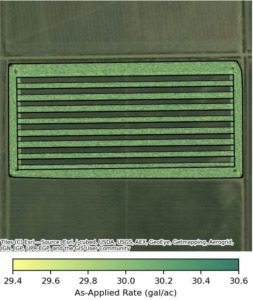
Figure 1: As-applied fungicide map of an on-farm trial.
Moreover, the payoff, short and long term, can be higher than expected. When near-term profit matters, one proven approach is a high-touch service tier that pairs on-farm testing with high-margin services like soil and tissue sampling or variable-rate seeding and fertility prescriptions. Longer term, no one is better positioned to advise on what works locally than a retailer or agronomist pooling trial results across many growers and weather-years. Showing customers year over year which products work in their fields builds a pricing advantage: when growers trust a product works, or can be placed where it will, they share more of the value it creates. Furthermore, growing proprietary trial datasets plus technology improvement may unlock new predictive power, such as flagging which fields need a foliar microbial application and which don’t. Companies acting now will have years of data ready when that capability arrives, and will leap ahead.
One final factor: manufacturers face growing pressure to cut time-to-market on new inputs. Paired with the need to differentiate seemingly-identical products, this will push more inputs to go to market with warranties backed by in-field testing, like Growers Edge Side by Side Crop Plan Warranties, see example here. Building a culture of on-farm testing across your team and customers makes the step to selling warrantied inputs far easier.
Companies we view as best in class here include Asmus Farm Supply, InDepth Agronomy, and Total Acre, each helps growers in their regions learn which inputs deliver on their own farms, and which don’t. All three have strong precision ag capabilities, which lowers the incremental lift of launching a program. However this advantage may shrink because AI’s most immediate use cases in ag include:
- Faster, cheaper software support, so teams get more from software they already own, for example, having a chatbot explain how to use an advanced precision ag feature in John Deere Operation Center.
- Quickly building custom software for specific needs, for example, a field-trial tracking and invoicing app with customer and administrator views.
In short, rising competition among retailers and agronomists, a saturated input market, shrinking public research, and affordable, easy-to-use trial tools all point the same way: on-farm testing is becoming essential to building and keeping a competitive edge. In a market overflowing with options, local product-efficiency data remains the surest foundation for advice growers can trust and act on.